Before there were motorized vehicles and radial tires, we relied on horses for transportation, shoed with iron horseshoes to protect their hooves. The horseshoes were kept in place by nailing them to the insensitive section of the horses’ hooves. The demand for iron horse nails was worldwide. Before the industrial revolution horse nails were hand forged by local blacksmiths. To meet the increasing demand machines were designed to mass produce horse nails. These machines required access to waterpower and supplies of wrought iron. Clinton County had both. The Ausable and Saranac Rivers could provide the waterpower, and an active iron works industry would provide locally sourced raw materials. In addition, there was an established transportation system by rail and on Lake Champlain.
The J.&J. Rogers Company and The Peru Steel and Iron Company owned the primary iron works in Clinton County with factories located in the towns of Black Brook and Ausable. Both iron works produced and exported horse nails. The Ausable Horse Nail Factory located in Keeseville was organized in 1863 and produced about 100 tons of horse nails with 10 machines. By 1880, fifty-four machines produced 1,000 tons of finished horse nails. The Peru Iron and Steel Company created the mining and manufacturing village of Clintonville and by 1845 produced 1,800 tons of horse nails annually.
In 1874 J.D. Kinsland began manufacturing horse nails in Vergennes, Vermont using a machine invented by James Mills of Keeseville. In 1875, Mr. Kinsland and his partners Elric Nicholes and John W. Lynde of Plattsburgh and Henry N. Mitchell of Burlington reorganized the company in the name of the Saranac Horse Nail Company with the intention of moving the operation to Plattsburgh, New York. The Plattsburgh Sentinelin October 1875 speculated that a factory would soon be established in Plattsburgh, and it was hoped that it would have the same impact on Plattsburgh as the Ausable Horse Nail Factory had on Keeseville.
On January 8,1878 the company was reorganized again, with a new charter, with officers; Hon. Shepard Bowen President and General Business Manager; H. Veeder Vice President; John W. Lynde Treasurer. Later in the spring of 1878 the Saranac Horse Nail Company purchased approximately nine acres of land from the Honorable S.M. Weed located on the east side of the sharp bend in the Saranac River about 300 yards above the lower dam (of what is now Durkee Street)with one half the water privileges. This location was known as the “Middle Power” for many years. On June12, 1878 the construction of a dam was started and completed “when the water was low”. After the dam was completed the brick horse nail factory was built on the high ground just south of the government line. In the middle of November 1878, twelve machines were brought from Vergennes and installed in the new factory. The factory also contained a machine shop where new machines were manufactured. The machines were known as the ”Mills” machines with the patent owned by the company. The factory’s superintendent was William H. Lang. On November 21stthe first horse nails were manufactured in Plattsburgh. Initially about 35 men and boys were employed by the company.
The Saranac Horse Nails were forged(or hammered) hot from nail rods with about 65 nails forged per minute. The nails are then put into tumblers for polishing. After polishing, the nails were fed into the finishing machine where the point was rolled out and trimmed. The nails were blued and polished depending on the customer’s order and were available in six sizes that were shipped in 25-pound boxes.
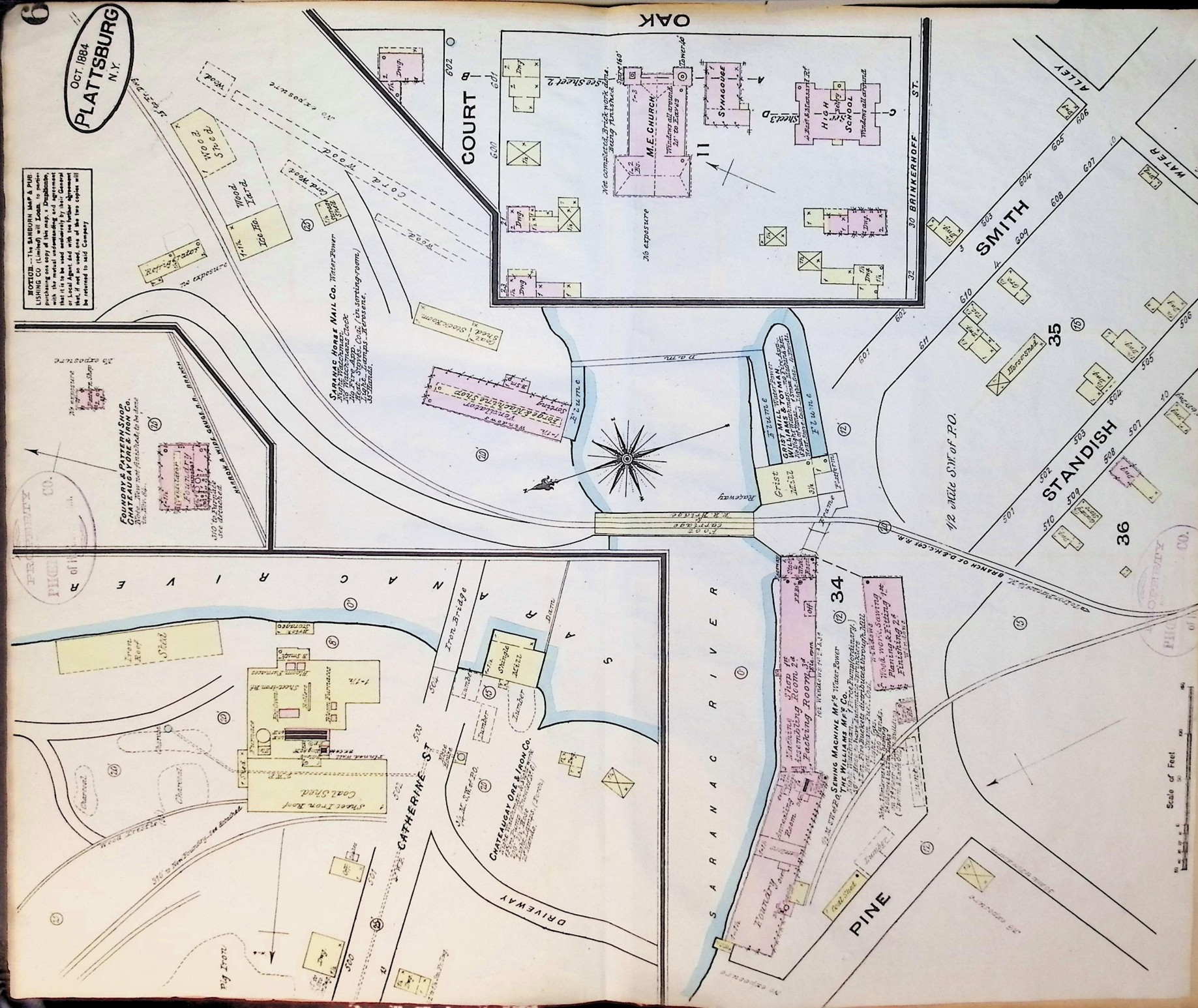
The Sanborne Fire Insurance Map of Plattsburgh in 1884 illustrates the footprint of the Saranac Horse Nail Factory including the dam and flume to provide power, the primary facility, forge and machine shop, wood yards, coal shed, and an icehouse/refrigeration house.
It was the opinion of the Saranac Horse Nail Company that the Mills machine produced a stiffer nail from iron produced in the North Country of New York than those made from iron produced in Norway or Sweden. The establishment of the Saranac Horse Nail Factory was considered a significant step for the iron business in the Saranac Valley and would allow iron mined in the valley to be used locally and not exported toother regions.
The primary source of iron used by the Saranac Nail Company was from Bowen and Signor’s forges at the “Saranac Hollow” about 17 miles north of Plattsburgh near the junction of the north and south branches of the Saranac River.
The partnership of Shepard P. Bowen and James H. Signor had been formed in 1871 and consisted of forges at Saranac Hollow, Russia, and the Tremblay Ore Bed at Williamsburg. The ore was mined from the Tremblay Ore Bed which was one mile south of Redford on the south side of the Saranac River. The vein was about thirty feet wide and had six shafts sunk to the depth of 100 to 150 feet. The forge at the Saranac Hollow produced 35 tons of slab iron a week which was used primarily for boiler flues, water and gas pipes, and steam boilers. The forge in Russia produced about 50 tons of iron billets a week that was primarily for wire/iron rods.
On March 17,1883 at the Saranac Horse Nail Factory annual meeting Shepard B. Bowen, S.F. Vilas, D.F Dobie, James H. Signor, and Andrew Williams were elected Directors of the company who in turn elected the following officers: President and Treasurer A. Williams, Vice President S.F. Vilas, and Secretary W.S. Guibord. About this same time things began to change economically on a national level. An economic recession had begun resulting in falling prices, reduced returns on investment, and financial stress. In addition, the iron industry rapidly declined during this period. New iron regions in the west provided economies of scale for mining and smelting that were unattainable in the Adirondack-Champlain region and made it difficult to compete. Many ore deposits once viewed as "inexhaustible" in the Adirondack-Champlain region, had in fact become largely depleted along with forests that were clear cut to provide fuel for the furnaces. These events contributed to the closure of ironworks and doomed the Saranac Horse Nail Factory.
On March 16,1889, a foreclosure notice was printed in the Plattsburgh Republican, and the sale of the Saranac Horse Nail Factory took place on May11,1889 with the Plattsburgh Electric Light Company bidding $10,900 for the entire Saranac Horse Nail factory lot with the intention of moving their electric light plant there. In August of 1889 they reconstructed the flume and anticipated their new electric plant would be the most powerful and complete plant in the Champlain Valley.